When you decide to install solar panels, you want the best performance for your money. But one question often stands out: which way should solar panels face? This single choice can change how much power your system makes, how quickly you see savings, and even how well your panels work year-round. The answer is not as simple as “point them south” or “face them towards the sun.” There are details most people miss, and a few mistakes can cost you thousands over the lifetime of your system.
This article will take you through everything you need to know—whether your panels are going on your home, business, or even a van. You’ll learn how direction, roof angle, your location, and even your daily habits affect solar performance. You’ll see real-world examples, common myths, and proven advice based on science and experience.
By the end, you’ll know exactly how to choose the best direction for your solar panels—and avoid mistakes that many beginners make.
Why Solar Panel Direction Matters
The direction your solar panels face, also known as azimuth, directly affects how much sunlight they capture. Sunlight is strongest when it hits the solar panel at a 90-degree angle. The more direct the sunlight, the more electricity your panels produce. A small change in direction can make a big difference in your total energy output over the year.
Some people believe that any direction is good as long as panels get some sun. This is not true. For example, facing panels west instead of south (in the Northern Hemisphere) can lower your annual energy production by 10–20%. Over 25 years, that’s a lot of lost power.
The right direction also affects:
- Payback period: How quickly your system pays for itself.
- Seasonal performance: Some directions are better for winter, others for summer.
- Grid savings: The direction may change how much power you use from the grid.
Choosing the best direction is the foundation for a successful solar energy system.
The Sun’s Path: What You Need To Know
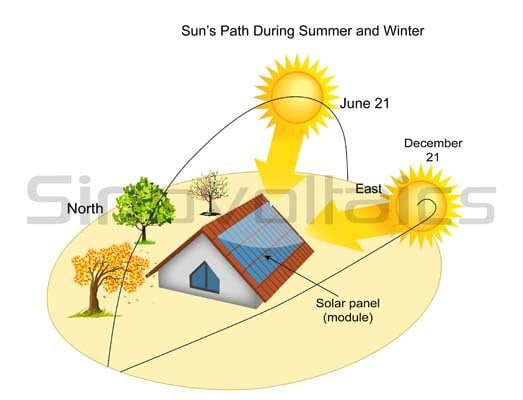
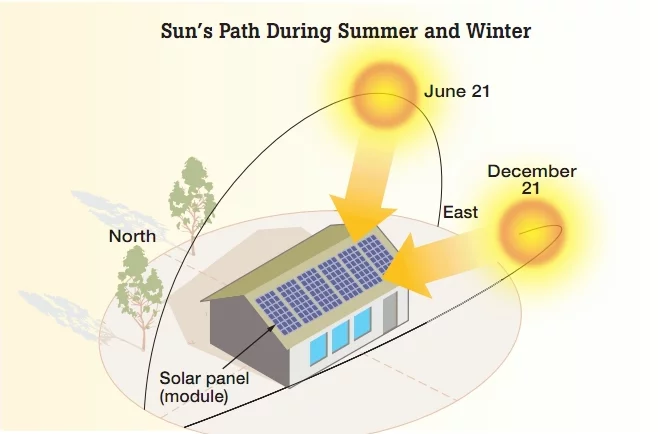
To understand the best direction for solar panels, you need to know how the sun moves across the sky. The sun rises in the east, climbs to its highest point in the south (for the Northern Hemisphere), and sets in the west.
The path is higher in summer and lower in winter.
The angle and direction of the sun’s path change depending on:
- Latitude: How far you are from the equator.
- Time of year: The sun is higher in June, lower in December (Northern Hemisphere).
- Local climate: Cloud cover, pollution, and weather can block sunlight.
The goal is to point your solar panels in the direction that gets the most sunlight during the hours when you need the most electricity.
Cardinal Directions: Which Is Best?
Let’s look at the four main directions and what they mean for solar panels.
South-facing Panels (northern Hemisphere)
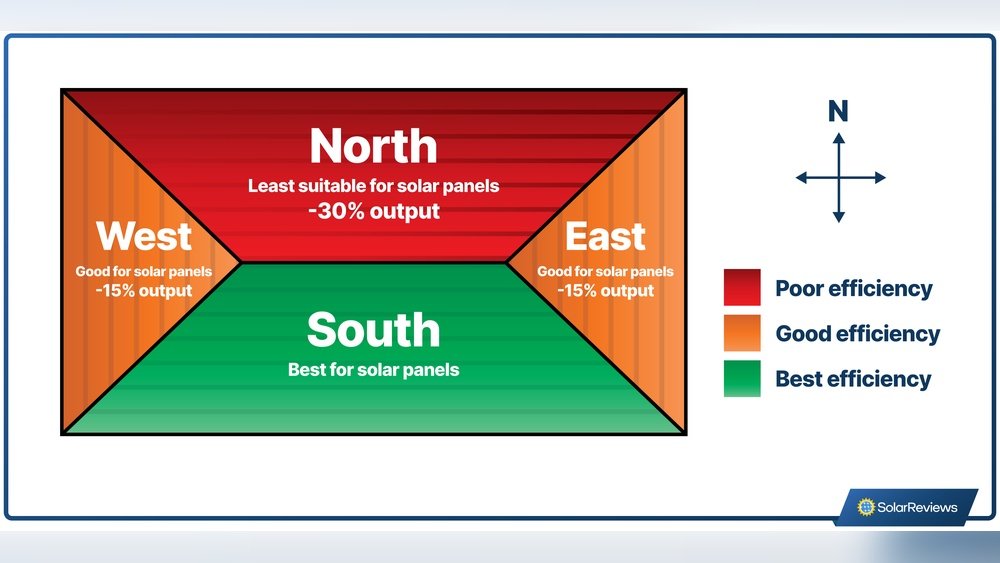
For most homes and businesses in the Northern Hemisphere, south-facing panels are the gold standard. South-facing panels get sunlight for the longest time each day. They receive strong midday sunlight, which is when solar panels are most productive.
Key Benefits
- Maximum annual output: South-facing panels usually generate 100% of the expected energy for your location.
- Best for grid-tied systems: Utility rates are often highest during midday, matching peak solar production.
- Balanced energy over the year: Good performance in both summer and winter.
When South Is Not Best
In rare cases, you might have special needs. For example, if your utility charges more for evening electricity, a slightly southwest-facing panel could help.
North-facing Panels (southern Hemisphere)
If you live south of the equator, the sun is always to the north. In Australia, South Africa, and much of South America, north-facing panels are ideal. The same reasons apply: maximum midday sun, high annual output, and good performance year-round.
East-facing Panels
East-facing panels catch the morning sun. This can be useful if:
- Your main electricity use is in the morning.
- You want to reduce grid use during breakfast hours.
But east-facing panels miss the strong midday and afternoon sun, so they produce less total energy. On average, east-facing panels generate about 80–90% of the energy of south-facing panels (Northern Hemisphere).
West-facing Panels
West-facing panels perform best in the late afternoon. This is useful if:
- Your main power use is after work or school.
- Your local utility has “time-of-use” rates with higher prices in the evening.
West-facing panels also produce less total energy than south, but may be financially smart if evening rates are high.
North-facing Panels (northern Hemisphere) And South-facing (southern Hemisphere)
Panels facing away from the sun’s path get much less energy. In the Northern Hemisphere, north-facing panels are almost never recommended. They produce 20–30% less power than south-facing panels. In the Southern Hemisphere, it’s the opposite: south-facing panels are the weakest option.
How Roof Angle (tilt) Affects Solar Panel Performance
Direction is only one part of the equation. The tilt angle—how steeply your panels are installed—also plays a big role. The perfect angle depends on your latitude.
How To Find The Best Tilt
A general rule is:
- Best tilt = your latitude (in degrees)
For example, if you live at 40° latitude, the best tilt is about 40°. This maximizes total energy over the year.
But there are reasons to adjust:
- Flatter tilt (lower than latitude): Better for summer production, or for flat roofs.
- Steeper tilt (higher than latitude): Better for winter production (when sun is lower in the sky).
Common Tilt Mistakes
Many installers use the roof’s angle to make installation easier. If your roof is very flat or very steep, this can cut solar output by 10–25%. In some cases, using tilt racks or adjustable mounts is worth the cost.
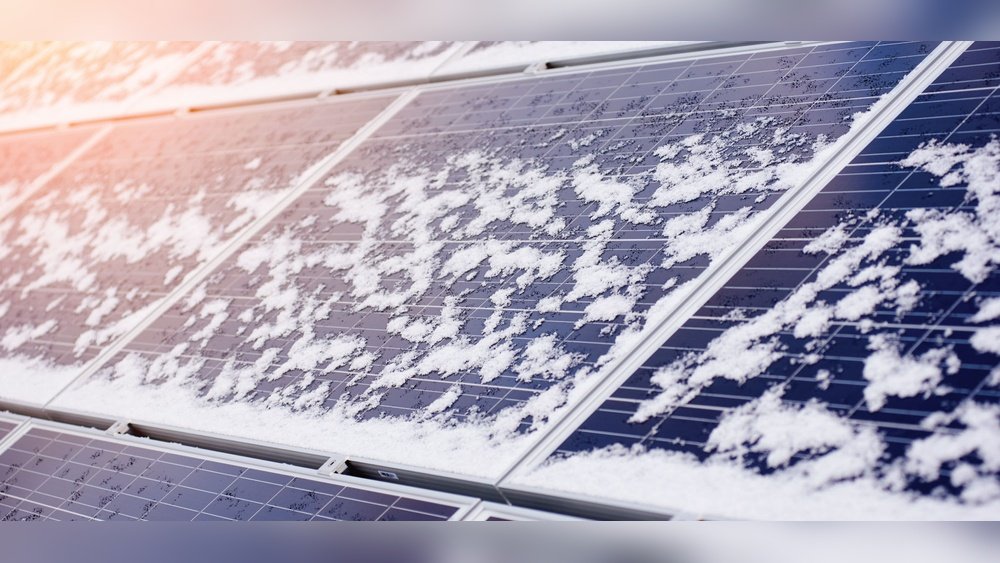
Non-obvious insight: In snowy regions, a steeper tilt helps snow slide off, keeping panels clean and productive.
Credit: sinovoltaics.com
Special Cases: When The Best Direction Changes
Not every home or business has a perfect south- or north-facing roof. Here are situations where the “standard” advice does not apply.
Roof Shape And Obstructions
- If your best roof faces east or west, you may need to install panels on those sides. It’s still worth it—modern panels are efficient, and electricity savings add up.
- Avoid shade from trees, chimneys, or nearby buildings. Even a small shadow can cut power by 50% or more.
Time-of-use Electricity Rates
Some utilities charge more for power used in the afternoon or evening. If you pay high rates after 4:00 pm, west-facing panels may actually save you more money, even if they produce less total energy.
Off-grid Systems
If you live off the grid, the best direction may match your main daily energy needs. For example, if you run pumps or machines in the morning, east-facing panels might work better.
Solar Tracking Systems
High-end systems use motors to follow the sun across the sky. These solar trackers can increase output by 25–35%. But they cost more and need maintenance. For most homes, fixed panels facing the optimal direction are more cost-effective.
Solar Panel Direction By Region
Your location changes everything. Let’s look at how solar panel direction works in different parts of the world.
United States And Canada
- Best direction: South (true south, not magnetic south)
- Best tilt: Equal to local latitude
- Special cases: In hot southern states, a flatter tilt can help reduce summer cooling costs.
Europe
- Best direction: South
- Best tilt: 30–40° for most of Western and Central Europe
- Special cases: In Nordic countries, a steeper angle (up to 60°) works better for low winter sun.
Australia And New Zealand
- Best direction: North
- Best tilt: 20–35°, depending on your city
- Special cases: In tropical north, a flatter tilt helps with summer sun.
Asia
- Best direction: North (southern Asia), South (northern Asia, e.g., China, Korea, Japan)
- Best tilt: Varies widely—20–40° is common.
Africa And South America
- Best direction: North (Southern Hemisphere), South (Northern Hemisphere)
- Best tilt: 10–30°, depending on latitude.
Non-obvious insight: In tropical regions near the equator, direction matters less—panels get strong sun from all sides. Tilt is more important for rain runoff and cleaning.
How Much Does Direction Really Affect Output?
Here’s a comparison to show how much direction changes your solar output. Assume a 5 kW system, clear weather, and no shade, in the Northern Hemisphere.
| Panel Direction | Annual Output (% of South) | Best Use Case |
|---|---|---|
| South | 100% | Max energy, general use |
| Southwest | 95–98% | Afternoon/evening use |
| West | 80–90% | Peak evening rates |
| East | 80–90% | Morning-heavy use |
| North | 70–80% | Rarely recommended |
Even “non-ideal” directions can still be worth it if you have enough roof space and the cost is right.
How To Find True South Or North
Most people assume their house faces “south” or “north,” but compass readings can be off by 10–15 degrees due to magnetic variation. For best results:
- Use a smartphone app to find true south (Northern Hemisphere) or true north (Southern Hemisphere).
- Check with a solar pro—they use special tools to measure direction and tilt.
- If you must use a compass, correct for magnetic declination (the difference between magnetic and true north).
Credit: sunsolarsolutions.com
Impact Of Direction On Solar Payback Time
Your payback time is how long it takes for your solar system to “pay for itself” through energy savings. The better the direction, the faster you reach this point.
For example:
- South-facing panels: Payback in 6–8 years (typical for the US)
- West-facing panels: Payback in 7–10 years, but possibly faster if you avoid high evening rates
A poor direction (north-facing in the Northern Hemisphere) can add years to your payback time—or make the system a bad investment.
Solar Panel Direction For Different Roof Types
Not all roofs are created equal. Here’s how solar direction works for common roof shapes.
Gable Roofs
Most common in homes. If the ridge runs east-west, you get a perfect south- or north-facing slope. If not, you may need to split panels on both sides.
Hip Roofs
Four sloped sides. You may need to use east, west, and south/north sides. Output will be a mix.
Flat Roofs
You can build racks at the perfect tilt and direction. Flat roofs are common on commercial buildings.
Shed Roofs
Single slope, often facing east or west. Panels will follow the roof, but output may be lower.
Tip: If your roof faces a less ideal direction, ask your installer about tilted racks or ground mounts.
How Shading And Obstacles Affect Direction Choice
Sunlight is easily blocked—by chimneys, trees, utility poles, or even roof vents. Panels in shade produce much less electricity. When choosing direction:
- Place panels where they’ll be unshaded for at least 6 hours a day.
- Use a “solar pathfinder” tool to check for shade at different times of year.
- Microinverters or power optimizers can reduce the damage from partial shading.
Non-obvious insight: Even if your roof faces the right direction, heavy shade can make solar a poor investment. Sometimes a slightly less optimal direction with no shade produces much more energy.
Solar Panel Direction For Ground Mount Systems
If you have land, ground mounts let you choose any direction and tilt. Usually, you’ll aim for true south/north and the best tilt for your latitude.
Benefits:
- Perfect direction and angle
- Easy to clean and maintain
- Can be expanded as needed
Drawbacks:
- Takes up land space
- May need fencing for safety
Direction For Solar On Rvs, Vans, And Boats
Mobile solar is different. You can’t always face panels in the best direction, but you can:
- Park facing the ideal direction when possible.
- Use tilt mounts to adjust angle as needed.
- Add extra panels to make up for less-than-perfect direction.
For people who travel north and south during the year, a flat mount is often best. It averages out the sun’s angle as you move.
Impact Of Direction On Battery Storage
If you use batteries (for off-grid or backup power), the direction of your panels affects how quickly your batteries charge.
- South/north-facing panels: Fastest recharge, especially midday.
- East-facing panels: Early charge, good if you need power in the morning.
- West-facing panels: Later charge, may help if you use power in the evening.
Tip: For battery systems, balance your main use times with the panel direction.
Real-world Examples
Let’s look at some real-life cases to see how direction affects solar performance.
Case 1: Suburban Home In California
- Roof faces southwest, 25° tilt
- 7 kW system, net metering (pays for extra power sent to grid)
- Output: 96% of a perfect south-facing system
- Payback: 7 years
Case 2: Apartment Building In Germany
- Flat roof, panels mounted at 35° facing due south
- 30 kW system, feeds power to tenants
- Output: 100% optimal
- Benefit: High output in winter, when electricity is expensive
Case 3: School In New Zealand
- Main roof faces east, 15° tilt
- 20 kW system
- Output: 85% of north-facing system
- Solution: Added extra panels to reach needed output
Case 4: Off-grid Cabin In Alaska
- Shed roof, south-facing, 60° tilt (steep for winter sun)
- 3 kW system, batteries for night use
- Output: Good winter performance, snow slides off panels
Case 5: Warehouse In Texas
- Flat roof, panels mounted at 10° facing south
- 100 kW system
- Output: Slightly lower than steeper tilt, but easier installation and less wind risk
These examples show that even if your direction is not perfect, solar can still work well with the right planning.
How To Measure Your Roof’s Direction And Angle
You don’t need fancy tools to check your roof’s direction and tilt.
- Use a smartphone compass app to find the direction your roof faces.
- Use an inclinometer app or a simple protractor to measure tilt.
- Check your local latitude (Google “what is my latitude?”).
With this info, you can compare your roof to the ideal direction and tilt.
Online Tools And Resources
Many free tools can help you check the best direction for solar panels at your location.
- PVWatts Calculator (NREL): Estimates energy output for any direction/tilt in the US.
- Global Solar Atlas: Gives solar potential data for any spot on Earth.
- Google Project Sunroof: Shows solar potential for your address (limited countries).
These tools let you see the real impact of different directions—before you spend a penny.
Common Myths About Solar Panel Direction
Let’s clear up some popular myths:
- Myth: Panels must face directly south/north to work.
Fact: Panels still work well up to 30° off the ideal direction.
- Myth: Only the direction matters, not the tilt.
Fact: Both are important. Bad tilt can cut output by 10–25%.
- Myth: If your roof doesn’t face the best way, solar isn’t worth it.
Fact: With modern panels and falling prices, east or west roofs can still save money.
- Myth: Trees or shade don’t matter if the direction is good.
Fact: Shade is much worse than direction problems. Avoid it if possible.
Factors To Consider Before Finalizing Panel Direction
Before you decide, think about:
- Your main energy use times (morning, afternoon, evening)
- Local utility rates (do they change by time of day?)
- Roof shape and available space
- Shade from trees/buildings
- Future changes (new buildings, trees growing)
- Local weather (clouds, snow, dust)
Get quotes and simulations from several installers. They will often run computer models to show you the best direction for your unique situation.
Data Table: Effect Of Direction And Tilt On Output
Here’s a look at how both direction and tilt work together, using a 5 kW system at 40° latitude.
| Direction | Tilt Angle | Annual Output (% of Ideal) |
|---|---|---|
| South | 40° | 100% |
| South | 20° | 96% |
| West | 40° | 84% |
| East | 20° | 88% |
| North | 40° | 72% |
This shows that getting both direction and tilt right matters most.
What If Your Roof Faces The Wrong Way?
Don’t give up on solar. Here are options if your roof isn’t perfect:
- Use more panels to make up for lower output.
- Install panels on a garage, shed, or carport.
- Build a ground-mounted system.
- Use “bifacial” panels that capture light from both sides (works best on flat roofs).
Solar is flexible—almost any building can use it with the right plan.
Mistakes To Avoid When Choosing Solar Panel Direction
Many people (and even some installers) make these errors:
- Ignoring true direction: Using “compass south” instead of true south/north.
- Not checking for shade: Panels in shade are almost useless.
- Forgetting about time-of-use rates: Sometimes west-facing panels save you more money.
- Using the roof’s tilt without checking: Very steep or flat roofs may need racks.
- Overlooking future changes: Trees grow, buildings go up—think ahead.
Ask your installer for a detailed “shade analysis” and a production estimate for your exact roof.
The Role Of Solar Design Software
Professional installers use advanced software to model your roof, local weather, and sunlight for each possible direction. These tools include:
- Helioscope
- PVsyst
- Aurora Solar
These programs show:
- Estimated annual and monthly output
- Payback time for each direction
- Impact of shade, tilt, and other factors
Tip: Ask for a copy of your solar simulation before signing any contract.
Solar Panel Orientation For Future Technologies
New technologies are making solar even more flexible:
- Bifacial panels: Work well even if light reflects from the ground.
- Building-integrated PV (BIPV): Panels built into windows, walls, or roofs. Direction is less critical but still matters.
- Smart inverters: Can adjust for partial shading and changing sunlight.
The basic rules of direction still apply, but new tech gives you more options.
Environmental Impact Of Panel Direction
More efficient panel direction means you get more clean energy from the same amount of hardware. This reduces your “carbon payback time”—how long it takes for your system to offset the energy used to make it.
For example, a south-facing system may offset its own carbon footprint in 2 years, while a poorly oriented system could take 3 or more.
Solar Panel Direction And Maintenance
The right direction can even affect how easy it is to keep your panels clean.
- Steeper panels shed snow and dust better.
- Flat panels need more cleaning (rainwater may not run off).
- Panels under trees (even if facing the right way) may get dirty faster due to leaves and bird droppings.
Plan your system for both high output and easy maintenance.
The Bottom Line: What Should You Do?
Here’s a simple plan to get the best from your solar system:
- Find your roof’s true direction and tilt.
- Check for shade at all times of year.
- Compare your roof to the ideal (south/north, tilt = latitude).
- Think about your main energy use times and local rates.
- Use online tools or get a professional solar simulation.
- Make changes if needed (tilt racks, extra panels, ground mount).
- Ask for a detailed production estimate before you sign any contract.
With a little planning, you can get great results—even if your roof isn’t perfect.
Frequently Asked Questions
What Is The Best Direction For Solar Panels In The Northern Hemisphere?
The best direction is true south. Panels facing true south receive the most sunlight during the year, producing the most electricity. If true south is not possible, southeast or southwest is a good backup.
What About The Southern Hemisphere—should Panels Face North?
Yes, in the Southern Hemisphere, true north is best. This is because the sun is always to the north in these regions. North-facing panels get the most sun and produce the most power.
Does The Angle (tilt) Of The Panels Matter As Much As The Direction?
Yes. Both direction and tilt are important. The best tilt is usually equal to your latitude. If your roof is much steeper or flatter, you may lose 10–25% output compared to the ideal tilt.
Is It Worth Installing Solar Panels If My Roof Faces East Or West?
Often, yes. East- or west-facing panels produce 80–90% of the energy of south/north-facing panels. With today’s lower panel prices, they can still save you money—especially if your main energy use matches those times of day.
Where Can I Find More Information About Solar Panel Direction For My Location?
You can use online tools like the NREL PVWatts Calculator for accurate estimates based on your address.
Choosing the best direction for your solar panels is a smart move. With the right information and careful planning, you’ll enjoy clean energy, lower bills, and a system that works for decades—no matter which way your roof faces.
Credit: sinovoltaics.com