Every day, sunlight falls on rooftops, fields, and open spaces around the world. For many people, solar panels are a way to turn that free sunlight into usable electricity. But a common question comes up: How much energy can one solar panel produce? The answer is not as simple as a single number. Many factors affect the electricity that a solar panel can generate, from the panel’s size and efficiency to the amount of sunlight available in your location. Understanding these factors helps homeowners, businesses, and anyone interested in solar power make better decisions.
This guide will explore everything you need to know about the energy output of a single solar panel. You will learn about different types of solar panels, how they are rated, what real-world conditions affect their performance, and how to estimate the electricity you can expect from your own solar installation.
Whether you are planning a small rooftop system or just curious about solar energy, this article offers clear explanations, practical examples, and expert insights to help you make sense of solar panel energy production.
What Does Energy Output Mean For A Solar Panel?
Before diving into numbers, it’s important to understand what “energy output” really means. In solar power, there are two key measurements:
- Watt (W): This is a unit of power. It shows how much energy a device can generate or use at any moment.
- Watt-hour (Wh): This is a unit of energy. It measures how much electricity is produced or used over time.
For example, if a solar panel is rated at 300 watts, that means it can produce up to 300 watts of power in ideal conditions at a given instant. If it runs at full power for one hour, it will produce 300 watt-hours of energy.
People often confuse these terms. Remember: watts tell you how much power at any instant, watt-hours tell you the total energy over time.
Standard Test Conditions: The Lab Vs. The Real World
Every solar panel is tested in a lab before it is sold. These tests happen under Standard Test Conditions (STC):
- Sunlight intensity: 1000 watts per square meter (like a bright sunny day at noon)
- Cell temperature: 25°C (77°F)
- Air mass: 1.5 (a measure of sunlight angle, similar to sun at about 1 pm)
Manufacturers use these conditions to rate their panels. A panel labeled as “300W” means it can produce 300 watts under these perfect lab conditions.
But in the real world, things are rarely perfect. Panels get hotter, clouds pass by, and the sun’s angle changes during the day. This means actual energy output is usually less than the lab number. Understanding this difference is key when planning a solar system.
Types And Sizes Of Solar Panels
Solar panels come in various types and sizes. The most common types are:
- Monocrystalline panels: Made from a single crystal structure. They are usually black and have the highest efficiency.
- Polycrystalline panels: Made from multiple crystal fragments. They are blue and slightly less efficient, but often cheaper.
- Thin-film panels: Very thin and flexible. Less efficient, but lighter and sometimes used for special applications.
Panels also come in different physical sizes and wattages. Here are some common examples:
- Residential panels: Usually between 250 and 400 watts, about 1.6m x 1m (5.5ft x 3.2ft)
- Commercial panels: Can be larger, often up to 450 watts or more
For example, a common home solar panel is rated at 350 watts. But two panels of the same physical size might have different wattages, depending on their efficiency.
Typical Wattage Ranges
Most panels for homes today are in the 300-400 watt range. Some high-end models can reach over 450 watts. Thin-film panels are often much lower, sometimes under 100 watts per panel.
Key Factors That Affect Energy Production
Many things can change how much electricity a solar panel produces. Here are the most important factors:
1. Sunlight (solar Irradiance)
The more sunlight a panel receives, the more energy it can produce. Sunlight strength is measured in kilowatt-hours per square meter per day (kWh/m²/day). This value is higher near the equator and lower near the poles.
For example, a sunny place like Arizona, USA can get over 6 kWh/m²/day, while a cloudy city like London might get only 2. 5 kWh/m²/day.
2. Panel Orientation And Tilt
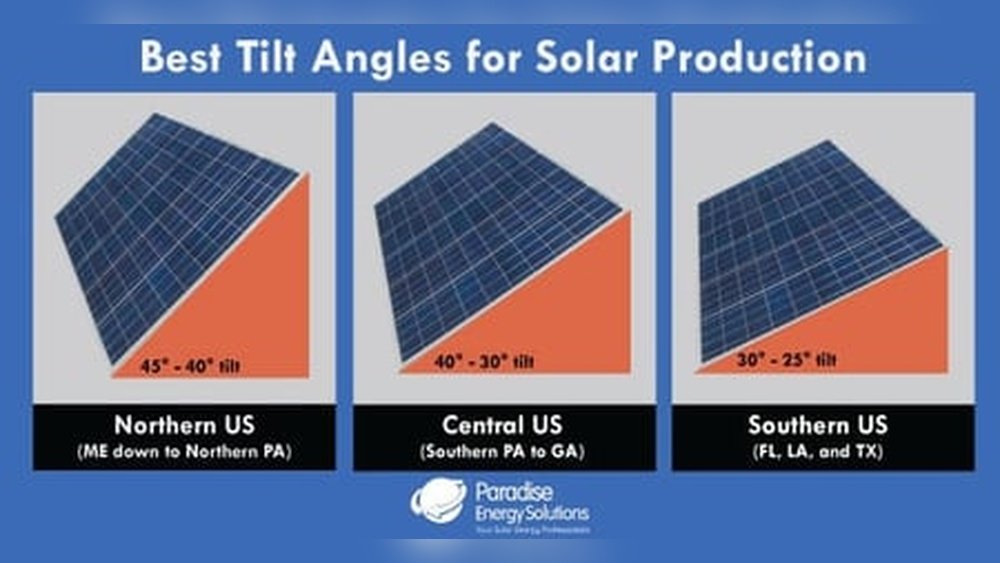
Panels work best when they face the sun directly. In the northern hemisphere, panels should face south; in the southern hemisphere, they should face north. The angle (tilt) should match your location’s latitude for best year-round performance.
3. Shading
Even a small shadow from a tree, chimney, or bird droppings can greatly reduce energy output. Panels in full sunlight produce much more energy.
4. Temperature
Solar panels actually work better when they are cool. High temperatures can reduce power output by 10% or more, especially in hot climates.
5. Panel Efficiency
Not all sunlight hitting a panel turns into electricity. Efficiency measures how well a panel converts sunlight into usable power. Most panels are 17%-21% efficient. Higher efficiency means more energy from the same size.
6. Dust And Dirt
Dust, pollen, or bird droppings on the panel surface can block sunlight and lower output. Regular cleaning helps maintain performance.
7. Panel Age And Degradation
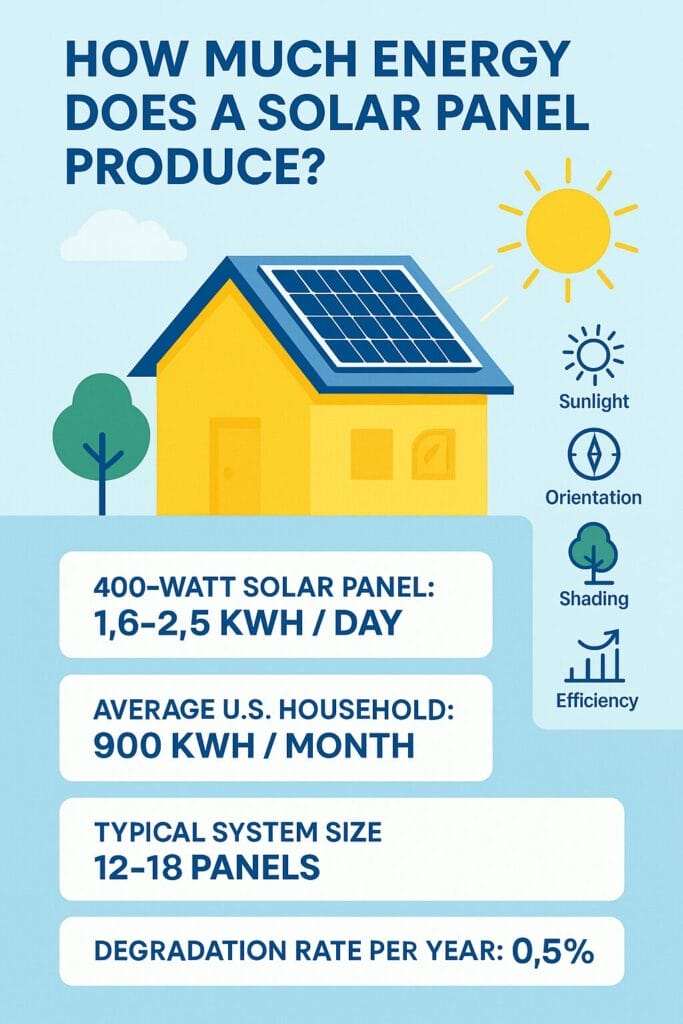
Panels slowly lose efficiency as they age. Most lose about 0. 5% of their output each year. After 25 years, a typical panel might still produce over 85% of its original power.
Real-world Example: Calculating Energy Output
Let’s say you have a 350-watt monocrystalline solar panel. You live in a city that gets an average of 5 hours of peak sunlight per day.
- Maximum daily energy = Panel wattage x Sun hours
- 350 watts x 5 hours = 1,750 watt-hours (1.75 kWh) per day
So, in one year:
- 1.75 kWh x 365 days = 638.75 kWh per year
But remember, this is an ideal estimate. Real output will be less due to temperature, dust, and shading.
Comparing Energy Output: Different Panel Types
Here’s a comparison of average daily energy output for three common panel types, each rated at 350 watts, in a location with 5 sun hours per day.
| Panel Type | Efficiency (%) | Daily Output (kWh) | Yearly Output (kWh) |
|---|---|---|---|
| Monocrystalline | 20 | 1.75 | 638.75 |
| Polycrystalline | 17 | 1.55 | 565.75 |
| Thin-film | 10 | 0.91 | 332.15 |
The table shows why panel type and efficiency matter. For the same sunlight, a monocrystalline panel produces much more energy than a thin-film panel.

Credit: www.youtube.com
How Much Energy Do You Need?
Knowing how much energy one solar panel produces is only part of the story. You also need to know how much energy you use. For example, the average U.S. home uses about 900 kWh per month (about 30 kWh per day).
If each panel produces 1.75 kWh per day, you would need about 17 panels to cover all your energy use:
- 30 kWh / 1.75 kWh ≈ 17 panels
Of course, every home is different. Some use much less, others much more. Knowing your own electricity usage helps you size your solar system correctly.
Solar Panel Output In Different Climates
Energy output changes a lot depending on where you live. Here’s a comparison of expected yearly output for a 350-watt panel in three different cities.
| City | Peak Sun Hours/Day | Yearly Output (kWh) |
|---|---|---|
| Los Angeles, USA | 5.5 | 702 |
| Berlin, Germany | 3 | 383 |
| Mumbai, India | 4.5 | 575 |
As you can see, a panel in Los Angeles produces nearly twice as much energy as the same panel in Berlin. Location is one of the biggest factors in solar energy production.
Credit: nrgcleanpower.com
Understanding Solar Panel Ratings
Solar panels are labeled with a few important numbers:
- Wattage (W): Maximum power under STC (for example, 350W)
- Efficiency (%): How much sunlight is converted to electricity
- Voltage (V): Output voltage under load (for example, 33V)
- Current (A): Output current at maximum power (for example, 10.6A)
- Temperature Coefficient: How much output drops as temperature rises
These numbers help you compare panels and understand what you are buying.
Practical Example: Reading A Panel Label
Imagine you see a label:
- Max Power: 340W
- Efficiency: 19.8%
- Voltage at max power: 34V
- Current at max power: 10A
- Temperature Coefficient: -0.35%/°C
This tells you the panel can produce up to 340 watts under perfect lab conditions, with high efficiency, and will lose about 0. 35% of output for each degree above 25°C.
Common Myths And Mistakes About Solar Panel Output
Many people misunderstand how solar panels work. Here are some common myths:
- My panel will always produce its maximum rating. In reality, this only happens in a lab. Real-world output is usually 70-90% of the rated maximum.
- Panels work the same everywhere. Output depends heavily on location, weather, and installation angle.
- Bigger panels are always better. Efficiency and quality matter as much as size. Sometimes, more efficient panels are worth the extra cost if space is limited.
- Cleaning is not important. Dust and dirt can cut output by 10% or more.
- Output drops to zero on cloudy days. Panels still work in indirect sunlight, though output is lower.
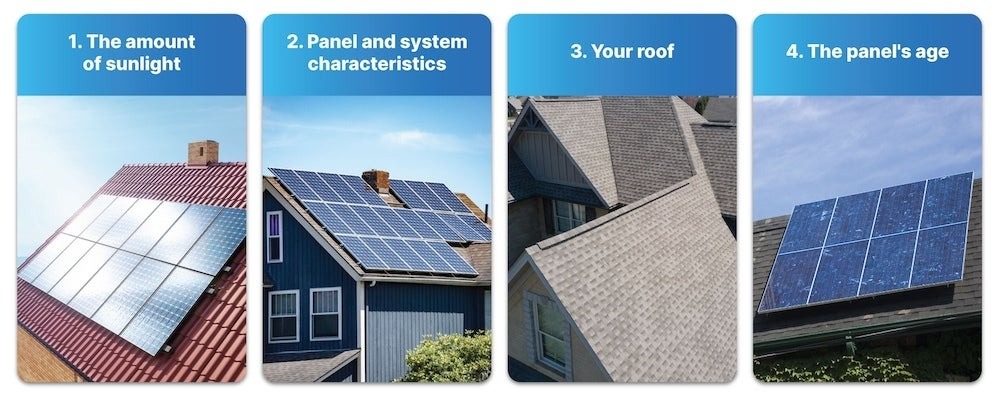
Credit: www.solarreviews.com
How To Maximize Energy Production
Getting the most from your solar panel means paying attention to a few important details:
Choose The Right Location
Install panels where they get the most sun, with no shading from trees or buildings. South-facing roofs are best in the northern hemisphere.
Use The Proper Tilt
Set the panel tilt angle to match your latitude for year-round energy. Adjustable mounts can help get the most from winter and summer sun.
Keep Panels Clean
Check panels every few months for dust, leaves, or bird droppings. Cleaning with water and a soft brush helps maintain high output.
Check For Obstructions
After installation, watch for new shading caused by growing trees or new buildings. Even partial shading can reduce output by half or more.
Monitor System Performance
Many modern systems include apps that show real-time energy production. This helps spot problems early and keep your system running well.
Solar Panel Output Vs. Household Appliances
To make solar power practical, it helps to know what common appliances use. Here are some examples:
- LED light bulb (10W): Runs for 175 hours on 1.75 kWh (one panel, one day)
- Laptop computer (60W): Runs for about 29 hours
- Refrigerator (150W average): Runs for about 11 hours
- Air conditioner (1000W): Runs for 1.75 hours
A single panel can power lights and small devices for a long time, but larger appliances need more panels.
How Many Panels To Power A Home?
Let’s look at a practical example. Suppose your home uses 900 kWh per month, and you live in a place with 5 sun hours per day. With 350W panels:
- Each panel gives about 1.75 kWh/day = ~52.5 kWh/month
- 900 kWh / 52.5 kWh ≈ 17 panels
If you have less sun (3 hours/day), you would need more panels:
- Each panel gives about 1.05 kWh/day = ~31.5 kWh/month
- 900 kWh / 31.5 kWh ≈ 29 panels
This shows why location matters so much.
Advanced Factors: Losses In The System
Energy is lost at several points between the panel and your appliances:
- Inverter losses: Converting DC from panels to AC for home use costs about 5-8%
- Wiring losses: Long or thin wires can waste 2-3% of energy as heat
- Soiling losses: Dust and dirt can cut output by 5-10%
- Temperature losses: Hot panels lose efficiency
Altogether, expect 10-20% less energy at your wall plug than the panel’s rating suggests.
Calculating Your Own Solar Panel Output
To estimate how much energy your own panel will produce, follow these steps:
- Find your panel’s wattage (for example, 350W)
- Check your local peak sun hours (search “solar insolation [your city]”)
- Multiply panel wattage by sun hours
- Example: 350W x 5 sun hours = 1,750 Wh (1.75 kWh) per day
- Multiply by number of panels for total system output
Remember to adjust down by 10-20% for system losses.
Non-obvious Insight: Don’t Forget Winter
Most people calculate average output, but forget that winter sun is lower. If you need reliable power all year, size your system for the lowest-sun months.
Non-obvious Insight: Panel Degradation Over Time
Plan for the fact that panels lose power slowly each year. Oversizing your system at the start can help ensure enough energy for decades.
Comparing Solar Panel Brands And Models
Not all panels are created equal. When choosing a panel, compare:
- Efficiency: Higher means more energy per square foot
- Warranty: Good panels have 25-year performance warranties
- Degradation Rate: Lower is better (look for <0.5% per year)
- Temperature Coefficient: Lower means less loss in hot weather
| Brand | Wattage | Efficiency (%) | Warranty (years) | Degradation Rate (%/year) |
|---|---|---|---|---|
| SunPower | 400 | 22.6 | 25 | 0.25 |
| LG | 380 | 21.7 | 25 | 0.33 |
| JA Solar | 340 | 20.1 | 12 | 0.55 |
Choose panels not just by price, but by quality and long-term performance.
Grid-tied Vs. Off-grid: How Output Matters
Solar panels are used in two main ways:
- Grid-tied systems: Panels power your home, and extra energy goes to the grid. You can use grid power at night or in bad weather. Output matters for how much you save on bills.
- Off-grid systems: Panels and batteries must provide all your power. Output must cover your needs even on cloudy days.
Off-grid systems often need more panels and batteries to ensure reliable energy.
The Role Of Inverters And Batteries
Solar panels produce DC (direct current) electricity. Most homes use AC (alternating current). An inverter changes DC to AC. Good inverters are efficient, but not perfect. Batteries are used in off-grid or backup systems to store energy for night or cloudy days.
Both inverters and batteries affect how much of your panel’s output you can actually use. High-quality components mean less energy is wasted.
Solar Panel Energy Output: Case Studies
Let’s look at three real-world examples.
1. Small Cabin In A Sunny Area
- 2 panels x 350W = 700W total
- Location: 5.5 sun hours/day
- Daily output: 700 x 5.5 = 3,850 Wh (3.85 kWh)
- Enough for lights, small fridge, and phone charging
2. Urban Home In A Cloudy City
- 20 panels x 350W = 7,000W (7 kW system)
- Location: 3 sun hours/day
- Daily output: 7,000 x 3 = 21,000 Wh (21 kWh)
- Covers most or all household use for an efficient home
3. Off-grid Farm With Battery Backup
- 40 panels x 400W = 16,000W (16 kW system)
- 5 sun hours/day
- Daily output: 16,000 x 5 = 80,000 Wh (80 kWh)
- Powers farm equipment, lights, water pumps, and stores extra in batteries
Each case shows how total energy output depends on the number of panels, panel wattage, and sun hours.
Why Energy Output Is Not The Only Important Factor
It’s easy to focus only on energy numbers, but other factors matter:
- Durability: Panels must withstand wind, rain, hail, and snow
- Warranty: Long warranties protect your investment
- Brand reputation: Reliable brands offer better support and quality
- Aesthetics: Some people prefer all-black panels or specific looks
Cheaper panels may have higher failure rates, lower warranty coverage, or faster degradation. Think long-term.
The Future Of Solar Panel Output
Solar technology continues to improve. New materials, like perovskite and bifacial panels, promise higher efficiency and more energy from each panel. In the future, panels may reach 30% efficiency or more, meaning more power from every square foot.
For now, careful planning, good installation, and regular maintenance are the best ways to maximize energy from today’s panels.
Environmental Impact Of Solar Panels
Solar panels produce clean energy with no pollution during use. Over their 25-30 year life, they save tons of carbon dioxide compared to coal or gas power. Making panels does use energy and materials, but most panels “pay back” their carbon footprint in 1-3 years.
Proper recycling of old panels is important for long-term sustainability. Many countries are building recycling systems for the future.
Solar Panel Output: Global Perspective
Different countries use solar energy in different ways. In Germany, small rooftop systems are common. In China and India, large solar farms power cities. In Australia, many homes have panels because of high sun and electricity prices.
Panels can work almost anywhere, but energy output depends on local sun and weather. Even in cloudy places, solar can make sense, though you may need more panels to meet your needs.
How To Monitor Your Solar Panel Output
Modern solar systems come with apps or online dashboards. These show:
- Real-time power (watts)
- Daily, weekly, and yearly energy (kWh)
- Alerts if output drops due to faults or dirt
Monitoring helps you spot problems early and get the most from your system.
How Much Money Can A Solar Panel Save?
Savings depend on local electricity prices and how much energy you use. In places with high rates, one panel’s 1. 75 kWh per day might save $0. 30-$0. 50 daily, or $100-$180 per year. Over 25 years, that’s $2,500-$4,500 per panel, not counting rising energy costs.
Many countries offer tax credits or rebates for solar installations. Check local rules for details. The U.S. Department of Energy offers updated information on solar incentives: U.S. Department of Energy.
Frequently Asked Questions
How Much Energy Does A Solar Panel Produce Per Day?
A typical residential solar panel (350W) produces 1.4 to 1.8 kWh per day in areas with 4-5 peak sun hours. This can be higher in sunny areas and lower in cloudy ones. The exact amount depends on panel wattage, efficiency, sun hours, and installation quality.
Does A Solar Panel Work On Cloudy Days?
Yes. Solar panels still produce energy on cloudy days, but output drops to 10-30% of maximum. Some light always passes through clouds, allowing panels to work, though not at full power.
How Long Do Solar Panels Last?
Most panels last 25-30 years or more. After 25 years, a typical panel still produces 80-90% of its original power. Regular cleaning and maintenance help maximize lifespan.
Can One Solar Panel Power A House?
No, one panel is not enough for a whole house. Most homes need 10-30 panels to meet all energy needs, depending on usage and sunlight. A single panel can power small devices or a few lights.
How Can I Increase My Solar Panel’s Energy Output?
To get more energy:
- Install panels where they get full sun
- Set the right tilt and direction
- Keep panels clean
- Avoid shading from trees or buildings
- Use high-efficiency panels if space is limited
Paying attention to these details can boost your panel’s output by 10-20% or more.
—
Solar panels are a powerful way to turn sunlight into electricity. But the energy you get from one panel depends on many factors, from the panel’s type and efficiency to your local climate and how you install and maintain it. By understanding these factors, you can estimate your own energy production, plan your solar system, and enjoy clean, reliable power for years to come. Whether you want to reduce your electric bill, help the environment, or become more energy independent, knowing how much energy one solar panel can produce is the first step towards a brighter future.