Thinking about switching to solar energy can feel overwhelming at first. You may ask yourself, how many solar panels do I need to power my home? The answer is not as simple as a single number. It depends on your energy use, where you live, your roof size, the type of panels you choose, and more. This guide will break down each factor, help you avoid common mistakes, and show you how to confidently plan your solar panel system. By the end, you’ll have the knowledge to make the right choice for your home, your goals, and your budget.
Understanding Your Energy Needs
Before you can decide how many solar panels you need, you must know how much energy you use. This is usually measured in kilowatt-hours (kWh) per month or year.
Understanding your energy consumption is the foundation of a good solar plan. Many people skip this step or guess, but this can lead to an undersized or oversized system. A solar system that’s too small won’t cover your bills, and one that’s too big wastes money.
How To Find Your Monthly Energy Use
1. Check Your Utility Bills
Your electricity bill shows how many kWh you use each month. Look for a section labeled “Usage” or “Consumption. ”
For example, if your last 12 bills show you used 900 kWh in January, 800 in February, and so on, add up all 12 months and divide by 12 to get your average monthly use.
Sometimes, your bill will show a graph for the year. This is a quick way to see your seasonal highs and lows. If you can, collect a full year of bills for the most accurate average.
2. Consider Your Lifestyle
Do you run air conditioners all summer or electric heaters in winter? Do you have a pool, an electric car, or work from home? These can all increase energy needs.
For example, if you have a home office with computers running all day, or you have children home during holidays, this will push your usage higher than the average.
3. Future Changes
If you plan to buy new appliances, a heat pump, or an EV, add their estimated consumption. For instance, charging an electric car might add 250-350 kWh per month.
Think about future plans, like adding central air, a hot tub, or switching from gas to electric appliances. It’s cheaper to size your solar for these needs now than to add more panels later.
Typical Home Energy Use
The average American household uses about 900-1,100 kWh per month. But this varies:
- Small apartments: 250–500 kWh/month
- Medium homes: 600–1,000 kWh/month
- Large homes: 1,200+ kWh/month
Homes with electric heating, older appliances, or multiple refrigerators can easily use 1,500 kWh or more each month.
Non-obvious insight: Many people underestimate their true energy use by forgetting about seasonal peaks (like hot summers or cold winters) or small devices that run all day.
For example, “phantom loads”—electronics like routers, DVRs, and chargers—use power all the time, even when not in use. These small draws add up over a year and should not be ignored.
How Solar Panels Produce Electricity
Solar panels convert sunlight into electricity. The amount they produce depends on panel wattage, the amount of sunlight (solar irradiance), and installation angle.
It’s important to know that solar panels generate direct current (DC) electricity, which your home doesn’t use directly. An inverter changes this to alternating current (AC) that your appliances use.
Panel Wattage
Most home solar panels are rated between 350 and 450 watts. This means, under perfect sunlight, one panel can produce up to its rated power.
A 400-watt panel, for example, means that in ideal lab conditions, the panel can generate 400 watts at a single moment. But real roofs are rarely “perfect. ”
Modern panels have increased in wattage over the past decade. Ten years ago, 250-watt panels were common; now, 400-watt and higher panels are standard for homes.
Sunlight Hours (peak Sun Hours)
A “peak sun hour” means one hour of sunlight strong enough to produce 1,000 watts per square meter. Most homes in the U.S. get 3 to 6 peak sun hours per day.
For example, California may get 5–6 hours, while Seattle gets 3–4.
Peak sun hours are not the same as daylight hours. You might have 12 hours of daylight, but only 4–6 hours are strong enough for good solar production.
You can look up your city’s average peak sun hours online, or ask a local installer for the number they use.
Efficiency Losses
No system is 100% efficient. Inverters, wiring, shade, and dirt reduce power by 10–20%. Most installers use a “derate factor” of 0.8–0.9 to account for losses.
Losses can come from:
- Inverter conversion (DC to AC)
- Dust and dirt on panels
- Wiring resistance
- Heat (panels lose efficiency as they get hot)
- Partial shading from trees or chimneys
Non-obvious insight: Don’t just look at the nameplate wattage. Real-world output is always less due to these losses.
If your system is exposed to more dirt, or your inverter is older, your losses could be higher. Regular maintenance helps keep efficiency closer to the maximum.
The Solar Panel Calculation Formula
Here’s a simple formula to estimate how many panels you need:
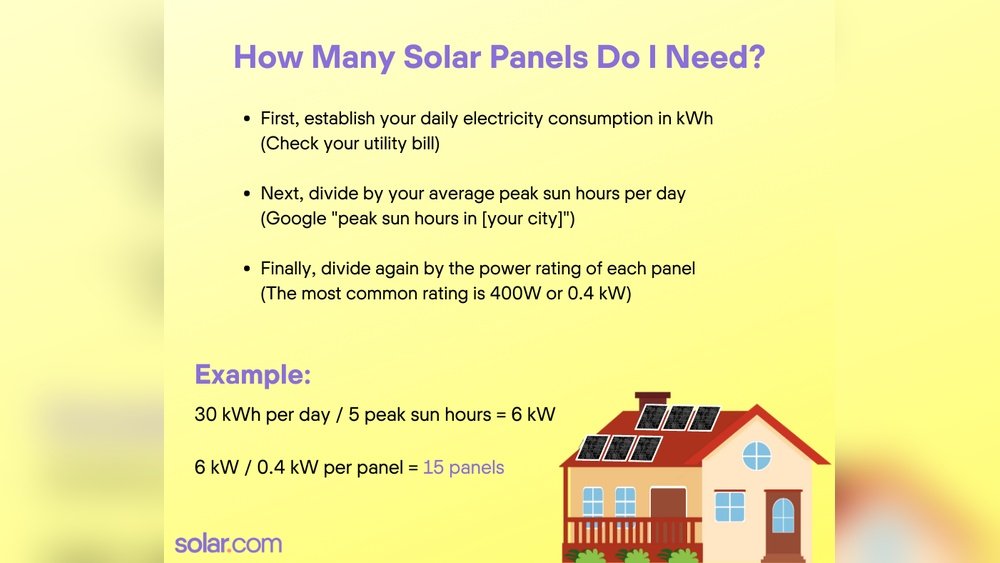
Number of Panels = (Monthly kWh Usage) / (Average Daily Sun Hours × 30 × Panel Wattage × Derate Factor)
But let’s break it down step by step.
Step 1: Estimate Daily Energy Need
Take your average monthly kWh and divide by 30 (days).
Example: 900 Kwh/month ÷ 30 = 30 Kwh/day
If your electricity use swings a lot by season, use your highest month to be sure your system meets your needs year-round.
Step 2: Estimate Solar Output Per Panel
Suppose you have 400-watt panels, get 5 sun hours per day, and use a derate factor of 0. 8.
Each panel’s daily output:
- 4 kW × 5 hours × 0.8 = 1.6 kWh/day per panel
If you choose a 350-watt panel, the output per panel will be a little less.
0.35 × 5 × 0.8 = 1.4 Kwh/day
Step 3: Divide Your Need By Panel Output
30 Kwh/day ÷ 1.6 Kwh/panel/day = 18.75 Panels
Round up. You’d need 19 panels.
This simple approach gives a good estimate. Installers may adjust based on your roof layout or add extra panels to cover system losses or changes in your energy use.
Factors That Affect How Many Solar Panels You Need
Every home is different. Here are the main things that change your panel count.
Home Location
Where you live changes how much sun your panels get. The Southwest U. S. gets more sun than the Northeast.
If you live in a desert region (like Arizona or Nevada), you’ll need fewer panels than someone in the Pacific Northwest. Even within the same city, local microclimates (foggy valleys, shaded neighborhoods) can affect output.
Roof Size And Shape
Small or complex roofs may not fit as many panels. You might need higher-efficiency panels.
A rectangular, south-facing roof is ideal for fitting the most panels. If your roof has dormers, skylights, or odd angles, some space will be wasted. Sketching your roof or using satellite images can help you see what’s possible.
Roof Angle And Direction
South-facing roofs at a 30–40 degree angle get the best sun. East or west-facing roofs produce less.
If your roof faces east or west, you may get up to 20% less energy. Flat roofs can use racks to tilt panels toward the sun, but this adds cost and may be visible from the street.
Shading
Chimneys, trees, or nearby buildings that shade your panels will lower output.
Even a small amount of shade can drop a panel’s output sharply. Microinverters or optimizers can help reduce the impact, but it’s best to avoid shade if possible.
Panel Type And Efficiency
High-efficiency panels (like monocrystalline) produce more power per square foot but cost more. Polycrystalline panels are cheaper but need more space.
If your roof is small or you want the most power possible, high-efficiency panels are a smart choice.
Local Weather
Cloudy, foggy, or snowy areas get less usable sunlight.
Snow can completely block solar production if it piles up on panels. In very cloudy climates, you’ll need more panels to make up for lost sun.
Battery Storage
If you want to store power for night use or backup, you may need extra panels to charge your batteries.
Batteries allow you to use solar power after sunset, but charging them requires generating more energy during the day.
Example Calculations For Different Homes
Let’s look at three real-world examples.
Small Apartment – 400 Kwh/month
- Daily use: 400 ÷ 30 ≈ 13.3 kWh
- Sun hours: 5
- Panel: 400 watts
- Derate: 0.8
- Panel output: 0.4 × 5 × 0.8 = 1.6 kWh/day
- Panels needed: 13.3 ÷ 1.6 = 8.3 (round up: 9 panels)
A small apartment with efficient appliances and no electric heating can be fully powered with fewer than 10 panels.
Typical Family Home – 900 Kwh/month
- Daily use: 900 ÷ 30 = 30 kWh
- Sun hours: 5
- Panel: 400 watts
- Derate: 0.8
- Panel output: 1.6 kWh/day
- Panels needed: 30 ÷ 1.6 = 18.75 (round up: 19 panels)
This is a common system size for a three-bedroom home.
Large Home With Pool & Electric Car – 1,500 Kwh/month
- Daily use: 1,500 ÷ 30 = 50 kWh
- Panel output: 1.6 kWh/day
- Panels needed: 50 ÷ 1.6 = 31.25 (round up: 32 panels)
If you have a pool, hot tub, and electric car, your needs may be much higher. This kind of system may require creative panel placement, possibly ground mounts.
Extra example:
A home in Seattle using 1,000 kWh/month, with 3.5 sun hours, and 400W panels:
- Daily use: 33.3 kWh
- Panel output: 0.4 × 3.5 × 0.8 = 1.12 kWh/panel
- Panels needed: 33.3 ÷ 1.12 ≈ 29.8 (round up: 30 panels)
Comparing Solar Panel Types
Here’s a simple comparison of the three main types of solar panels.
| Type | Efficiency | Cost | Space Needed | Common Use |
|---|---|---|---|---|
| Monocrystalline | 20–23% | High | Low | Homes with small roofs |
| Polycrystalline | 15–18% | Medium | More | Large roofs, lower budget |
| Thin Film | 10–13% | Low | Most | Specialty or commercial |
Monocrystalline panels are dark black and often look sleek. Polycrystalline panels have a blue tint and are less efficient. Thin film panels are flexible and lightweight but are rarely used for homes due to low efficiency.
Non-obvious insight: Some monocrystalline panels now come with “half-cell” technology, which means if one part of the panel is shaded, the other half keeps working. This is useful if you can’t avoid all shade.
Solar Panel Output By Region
Different parts of the U. S. get different amounts of sunlight. This affects how many panels you need.
| Region | Peak Sun Hours/Day | Panels for 900 kWh/Month |
|---|---|---|
| California (Los Angeles) | 5.5 | 16 |
| Texas (Dallas) | 5.0 | 19 |
| Florida (Miami) | 5.0 | 19 |
| New York (NYC) | 4.0 | 24 |
| Seattle, WA | 3.5 | 28 |
*Assumes 400W panels, 0. 8 derate factor. *
Non-obvious insight: If you live in a cloudy area, you may need 25–50% more panels than a sunny state.
Also, remember that high temperatures can lower solar panel output. Solar panels work better in cool, sunny weather than in extreme heat.
How Roof Size Limits Solar Panel Installation
Not every home has a big roof. Here’s how much space you need.
- One 400W panel is about 18 square feet.
- 20 panels need 360 square feet.
- Most homes have 1,000–2,000 square feet of roof, but not all of it is usable.
Obstacles like chimneys, skylights, and vents can block space or cast shade, making those roof sections unusable. Complex roof shapes or multiple roof sections make installation trickier.
Ways To Maximize Small Roofs
- Choose high-efficiency panels (more power, less space)
- Use both east and west sides if needed
- Clear obstructions like vents or antennas
Some installers can use “portrait” and “landscape” panel layouts to fit more panels in awkward spaces. In some cases, using both house and garage roofs can help.
Tip: Always check with a pro to confirm available space. Don’t forget to leave walkways for roof access.
If your roof is too small or shaded, ground-mounted solar systems are an option if you have yard space.
How Roof Direction And Tilt Affect Output
- South-facing roofs (in the northern hemisphere) get the most sun.
- East or west-facing roofs get 10–20% less output.
- Flat roofs can use tilted racks to face panels south.
A roof that faces southeast or southwest is still good, but pure north-facing roofs (in the northern hemisphere) are usually not recommended.
Best tilt angle is usually equal to your local latitude.
If you live at 40° latitude, a 35–40° tilt is best for yearly production. Some people choose a steeper tilt to maximize winter output if they use more energy in cold months.
Example
If you live at 35° latitude, a 30–40° tilt is ideal.
If your roof’s angle is much lower, solar installers can use mounting racks to get closer to the ideal angle, but this adds cost and may not always be possible due to local building codes or aesthetics.
Solar Panel Degradation Over Time
Panels slowly lose power as they age, usually 0.5% per year.
- After 10 years: About 95% of original power
- After 25 years: About 87–90% of original power
Quality panels degrade slower; cheap panels may lose power faster.
Tip: It’s smart to add 1–2 extra panels to make up for this slow loss.
Also, check your panel warranty—some brands guarantee 90% output after 25 years, while others only promise 80%.
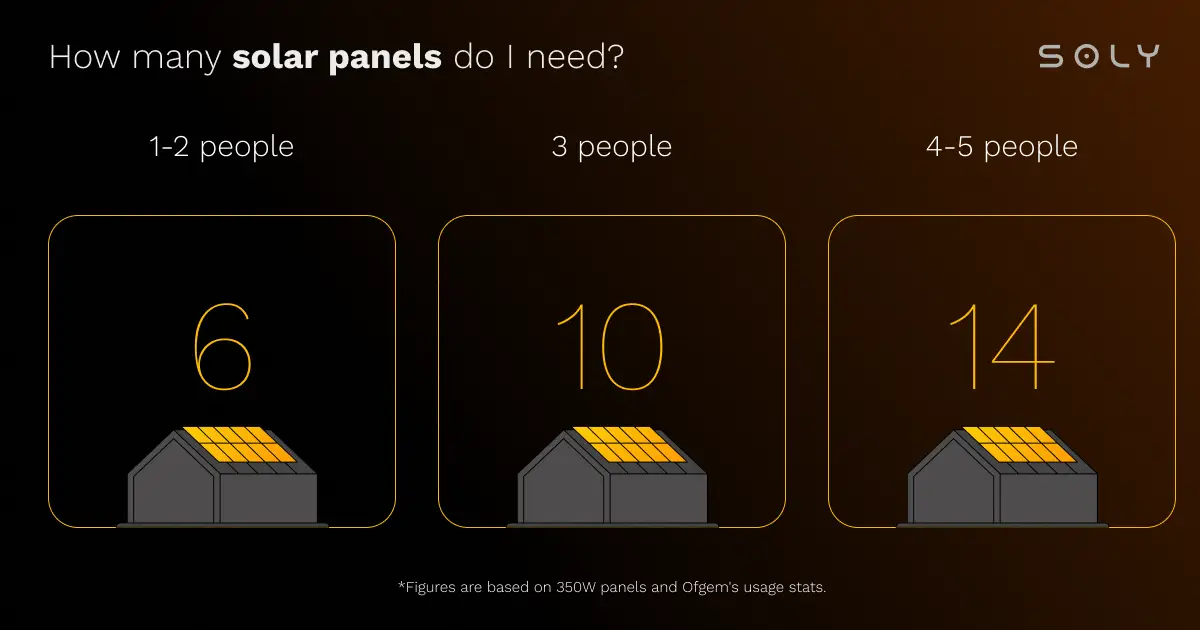
Credit: soly-energy.co.uk
How Adding Batteries Changes Your Panel Needs
If you want to store energy for night use or backup, you may need more panels.
- A typical home battery (like Tesla Powerwall) stores about 13.5 kWh.
- To fully charge it daily, you need about 8–10 extra panels.
If you want your system to power your home during a blackout or go off-grid, you must size both the panels and the batteries for your highest daily use.
Non-obvious insight: Most homes do not need enough batteries to go “off-grid.” Partial backup is more cost-effective.
A battery can keep critical appliances (fridge, lights, Wi-Fi) running for several hours, but powering everything (AC, electric range) needs much more storage.
Common Mistakes When Sizing Solar Panels
1. Only Using One Month’s Bill.
Energy use changes by season. Use a yearly average.
2. Ignoring Future Needs.
Plan for EVs, new appliances, or family changes.
3. Overlooking Shade And Roof Issues.
Even a little shade can reduce output a lot.
4. Not Including System Losses.
Inverters, wiring, and dirt can lower output by 10–20%.
5. Forgetting About Panel Degradation.
Add 1–2 panels to keep up with aging.
6. Not Considering Local Rules.
Some states limit system size or require permits.
Some homeowners also make the mistake of not checking local utility policies. Some utilities only allow systems that cover 100% of past use, not more.
Working With A Solar Installer
Most people choose a professional installer for solar. Here’s what to expect:
- The installer will measure your roof and check for shade.
- They’ll look at your energy use and suggest a system size.
- You’ll get a proposal showing number of panels, layout, and cost.
Installers often use special software to model your roof and simulate how much energy your system will produce in each season.
Tip: Get at least three quotes. Ask for the number of panels, panel brand and model, expected output, and warranties.
Don’t feel pressured to sign a contract on the spot. Good installers are happy to answer questions and explain their choices.
How To Reduce The Number Of Solar Panels You Need
There are two main ways: use less energy or get more from each panel.
Reduce Energy Use
- Upgrade to LED lighting
- Switch to high-efficiency appliances
- Improve home insulation
- Use smart thermostats
- Unplug devices when not in use
Replacing an old refrigerator can save 50–100 kWh per month. Sealing leaks and adding insulation can also cut heating and cooling costs.
Choose High-efficiency Panels
- Brands like SunPower and LG offer panels above 22% efficiency.
- Higher efficiency means fewer panels for the same power.
If roof space is tight, these panels are worth the higher price. Some high-efficiency panels also perform better in low light or hot weather.
The Cost Of Solar Panels
Solar panel systems are priced by the watt. In the U.S., the average cost is $2.50–$4.00 per watt before tax credits.
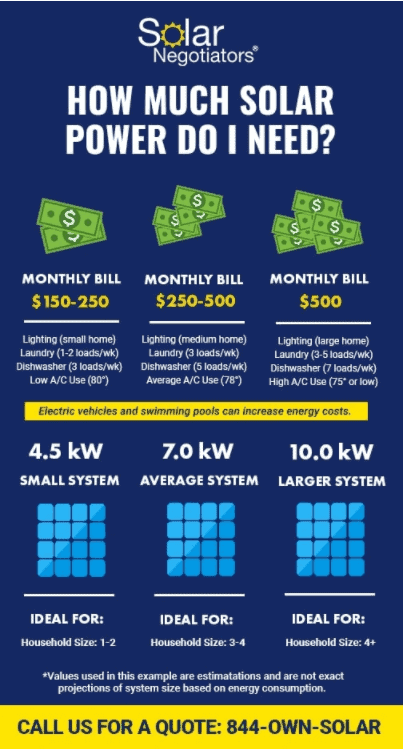
- 6 kW system (about 16 panels): $15,000–$24,000
- 10 kW system (about 25 panels): $25,000–$40,000
These prices include panels, inverters, permits, wiring, and labor. Prices vary by region, installer, and panel quality.
Incentives And Tax Credits
The federal solar tax credit lets you deduct 30% of the system cost. Many states and utilities offer extra incentives.
Some local programs offer rebates of $500–$2,000, or pay you for every kWh your system produces (called “performance payments”).
Tip: Check the Database of State Incentives for Renewables & Efficiency at DSIRE for local programs.
Timing matters—some state incentives have limited funds. Applying early can save thousands.
Grid-tied Vs. Off-grid Solar Systems
Most homes use grid-tied systems. Here’s the difference:
- Grid-tied: Uses solar power first, then draws from the grid. Sells extra power back to the utility.
- Off-grid: Needs batteries and backup. More panels required for cloudy days.
Grid-tied systems let you use the grid as a giant “battery. ” If your panels make extra power during the day, you send it to the grid and “buy” it back at night (net metering).
Note: Off-grid systems are more complex and expensive. Most homes do not need them unless they are very remote.
Off-grid homes need to plan for the worst case—multiple cloudy days in a row. This means more panels, bigger batteries, and usually a backup generator.
Credit: www.greenmatch.co.uk
Maintenance And Cleaning Impact
Dirty panels can lose 5–10% output. A simple cleaning every few months can keep them at peak performance.
- Rain helps, but in dusty or dry areas, you may need to rinse panels 2–4 times per year.
- Check for bird droppings, leaves, or snow.
If you live near trees, check for pollen and sap buildup in spring. In areas with heavy snow, a roof rake or gentle brush can help clear panels.
Tip: Most solar companies offer annual checkups.
They can test your inverter, check wiring, and make sure your system is still producing as expected.
Solar Panel Brands And Quality
Not all panels are equal. High-quality brands give better long-term performance and warranties.
- Top brands: SunPower, LG, Panasonic, Q Cells, Canadian Solar, REC
- Warranties: 20–25 years is best
Good inverters are just as important as good panels. Popular inverter brands include Enphase, SolarEdge, and SMA.
Non-obvious insight: Cheaper panels may save money upfront but can degrade faster or have lower warranties.
Ask your installer for production guarantees and see if they offer a “performance warranty” that promises a minimum yearly output.
Questions To Ask Before Installing Solar Panels
- How much energy will my system produce each month and year?
- What is the payback period (time to recover your investment)?
- What warranties do you offer on panels and inverters?
- How will you handle roof repairs or leaks?
- Will you help with permits and tax credit paperwork?
Also ask about monitoring: Most systems let you track your solar output by phone or computer.
Solar Panel Calculator Tools
Many websites offer free calculators to estimate your system size. They ask for your location, energy use, and roof size.
Popular options include:
- EnergySage
- PVWatts (from the National Renewable Energy Laboratory)
- Solar.com
Some calculators let you draw your roof layout or factor in shading from trees and chimneys.
Tip: Online tools are a good starting point, but a pro site visit will give the most accurate answer.
A site visit can reveal surprises—like a neighbor’s new tree or a hidden roof vent—that online tools can’t see.
The Step-by-step Process To Size Your Solar System
Here’s a quick recap of the process:
- Find your average monthly kWh use.
- Estimate your sun hours per day.
- Choose your panel wattage and efficiency.
- Calculate daily output per panel.
- Divide your daily need by panel output.
- Adjust for roof size, shading, and future needs.
- Add 1–2 panels for degradation and cloudy days.
- Get quotes from installers to confirm.
Don’t skip steps. Rushing leads to mistakes or disappointment later.
Real-world Example: Sizing A Solar System For A Family Home
Let’s say you have a home in Dallas, Texas.
- Monthly use: 1,000 kWh
- Sun hours: 5
- Panel: 400W (0.4 kW)
- Derate: 0.8
Daily Need: 1,000 ÷ 30 = 33.3 Kwh/day
Each Panel: 0.4 × 5 × 0.8 = 1.6 Kwh/day
Panels needed: 33.3 ÷ 1.6 = 20.8 (round up: 21 panels)
Roof space: 21 × 18 sq ft = 378 sq ft
Budget (average): 21 × $350 (per panel installed) = $7,350 (not including inverters, labor, etc.)
If your roof only fits 15 panels, you’d need higher-efficiency panels or to cut your energy use.
Credit: www.solarnegotiators.com
Solar Panel Sizing For Special Cases
Some homes have unique needs.
All-electric Homes
If you use electric heat, water heaters, and cooking, your usage could be 1,500–2,500 kWh/month. You may need 30–50 panels.
Upgrading to heat pumps or induction stoves increases energy use but can be balanced by adding extra panels.
Homes With Electric Vehicles
Add the EV’s annual use (usually 2,500–4,000 kWh/year) to your home’s total.
Charging at home is cheaper with solar, but make sure to include EV charging in your solar plan.
Net Zero Homes
If you want to cover 100% of your use, size the system for your highest month.
If your usage is 1,000 kWh in summer but only 600 kWh in winter, size your system for the 1,000 kWh month to truly reach net zero.
Vacation Homes
If you’re only there part-time, size for actual use—not what the utility reports for a full year.
Some people install smaller systems just to keep the fridge and security running, then use the grid for extra needs during visits.
How Many Solar Panels For Common Appliances?
Here’s how many panels common devices need:
- Refrigerator: 1–2 panels
- Electric oven: 2–3 panels
- Central AC (summer): 3–6 panels
- Electric car (daily charge): 3–5 panels
- Pool pump: 2–4 panels
*Assumes 400W panels, 5 sun hours, 0. 8 derate. *
If you add a hot tub or electric clothes dryer, these will also require extra panels.
Tip: If you’re adding a new device, plan for extra panels now to avoid paying more later.
How Many Solar Panels To Go Off-grid?
Going off-grid requires enough panels for the worst-case scenario (cloudy winter days).
- Most off-grid homes need 30–50 panels
- Must add batteries for night and stormy weather
- Requires generator backup for emergencies
Off-grid systems are much larger and more expensive. Sizing for several days of clouds or snow is a must, or you risk running out of power.
Non-obvious insight: Off-grid is usually 2–3 times more expensive than grid-tied.
You’ll also need to learn basic battery maintenance and be ready to reduce your energy use during long storms.
Environmental Impact Of Solar Panels
By switching to solar, the average home avoids 3–4 tons of CO2 per year—equal to planting about 100 trees.
Solar panels also reduce air pollution and reliance on fossil fuels.
Over a 25-year lifespan, a typical solar system can offset the emissions of driving a car for 100,000 miles. Solar panels themselves are recyclable at the end of their life, and manufacturers are improving eco-friendly designs each year.
Recap: Key Steps For Determining How Many Solar Panels You Need
- Know your average energy use
- Measure your sunlight hours
- Pick your panel type and size
- Factor in roof size and shading
- Adjust for future needs and battery storage
- Add a margin for system losses and degradation
- Get professional advice for a final check
Taking these steps will help you avoid wasted money and ensure your system matches your goals.
Frequently Asked Questions
How Many Solar Panels Do I Need For A 2,000 Sq Ft House?
It depends on your energy use, not just home size. The average 2,000 sq ft home uses 900–1,100 kWh/month. You’d likely need 18–24 panels of 400W each, assuming 5 sun hours and a derate factor of 0.8.
If you use electric heat or have a large family, you may need more.
Can I Run My Whole House On Solar Power Alone?
Yes, if you have enough panels and possibly batteries. Most grid-tied homes use solar for 80–100% of their power. Off-grid homes need more panels and batteries for backup.
Remember, running high-power devices like AC and electric ovens on solar alone may require a larger system and more batteries.
How Much Roof Space Do I Need For Solar Panels?
Each 400W panel is about 18 sq ft. For 20 panels, you’d need about 360 sq ft. Not all roof space is usable, so check for shade, vents, and obstructions.
If your roof is complex, ask an installer to make a layout plan.
What If My Roof Can’t Fit Enough Solar Panels?
You can:
- Use higher efficiency panels (more power, less space)
- Install panels on a garage or ground mount
- Reduce home energy use
Some people even install “solar pergolas” or carports to add more panels.
Do Solar Panels Work On Cloudy Or Rainy Days?
Yes, but less efficiently. Most panels produce 10–25% of their rated output on cloudy days. Size your system for your yearly average, not just sunny days.
Panels still work in winter, but snow cover can block sunlight completely until it slides off.
Switching to solar can seem complicated, but with careful planning, you can find the right number of panels for your home. Remember, every house is unique—energy use, roof space, and location all matter. Take your time, get advice, and soon you’ll be producing clean, affordable energy right at home.