The story of solar panels is a fascinating journey through science, human creativity, and our search for clean energy. When we look at modern solar panels powering homes, satellites, and even cars, it’s easy to forget that this technology took over a century to develop. Understanding when solar panels were invented means looking at a series of discoveries, early experiments, and continuous improvement. This article will guide you through the complete history, from the first scientific observations to today’s advanced solar modules.
Solar panels are everywhere now, but they didn’t appear overnight. Their invention is tied to many key moments in physics, chemistry, and engineering. By exploring these moments, you’ll see how curiosity and problem-solving have shaped the solar industry. We’ll cover the pioneers, important inventions, and the hidden steps that most people overlook.
If you’re curious about how solar panels came to be, and why they look and work the way they do today, you’re in the right place.
The Roots: Early Observations Of The Photovoltaic Effect
The invention of solar panels starts with the discovery of the photovoltaic effect—the process where light makes electricity in certain materials. This idea is the foundation of all solar panel technology.
Edmond Becquerel’s First Discovery (1839)
In 1839, a young French physicist named Edmond Becquerel made a breakthrough. He was only 19 years old when he noticed that shining light on a silver chloride solution (placed between two platinum electrodes) created a small electric current. This was the first time anyone saw electricity generated directly from sunlight. Becquerel didn’t understand exactly why it happened, but his experiment proved that light could produce electricity.
This discovery was surprising for its time. People knew about electricity and light as separate things, but the idea that sunlight could directly create electricity was new. Becquerel’s work inspired other scientists to try similar experiments, even though the effect was small and not understood.
Another detail that’s often missed: Becquerel’s apparatus was very simple, almost like a science fair project. Yet the outcome changed the direction of energy research for decades. Even though the current was tiny—far too small to power anything practical—it was proof of a new phenomenon.
The Term “photovoltaic” Appears
The word photovoltaic comes from two roots: “photo” (light) and “voltaic” (electricity, from Alessandro Volta). It describes how sunlight can generate electric power. For decades after Becquerel, scientists tried to understand the process, but practical use was still far away.
The term itself helped focus attention on this new effect. Naming something often helps scientists and inventors communicate and share ideas. By the late 1800s, “photovoltaic” was a known term in scientific circles, and the hunt for better materials and devices had begun.
The First Solar Cells: Selenium And Early Progress
After Becquerel, it took several decades before anyone made a device that could turn sunlight into electricity. The next big step happened with the element selenium.
Willoughby Smith’s Selenium Discovery (1873)
In 1873, British engineer Willoughby Smith was testing materials for underwater telegraph cables. He noticed that selenium changed its electrical resistance when exposed to light. This property, called photoconductivity, was important, but not the same as generating electricity directly.
Smith’s work showed that certain materials respond to light in surprising ways. Telegraph companies were interested, hoping this discovery would help improve long-distance communication. Selenium’s photoconductivity became a building block for more advanced experiments, leading to the first actual solar cells.
The First True Solar Cell: Adams And Day (1876)
Three years later, William Grylls Adams and his student Richard Evans Day built on Smith’s findings. They discovered that selenium could create electricity when exposed to light, without being heated. They made a simple cell that produced a tiny current. This was the first solid-state solar cell (a device with no moving parts, just solid materials). However, its efficiency was less than 1%, far too low for practical use.
An important detail: Adams and Day’s cell worked at room temperature, unlike previous attempts that needed heat. This showed the effect was truly “photoelectric,” not thermal. Their results were published in scientific journals, catching the attention of inventors and engineers.
Charles Fritts And The First Solar Panel (1883)
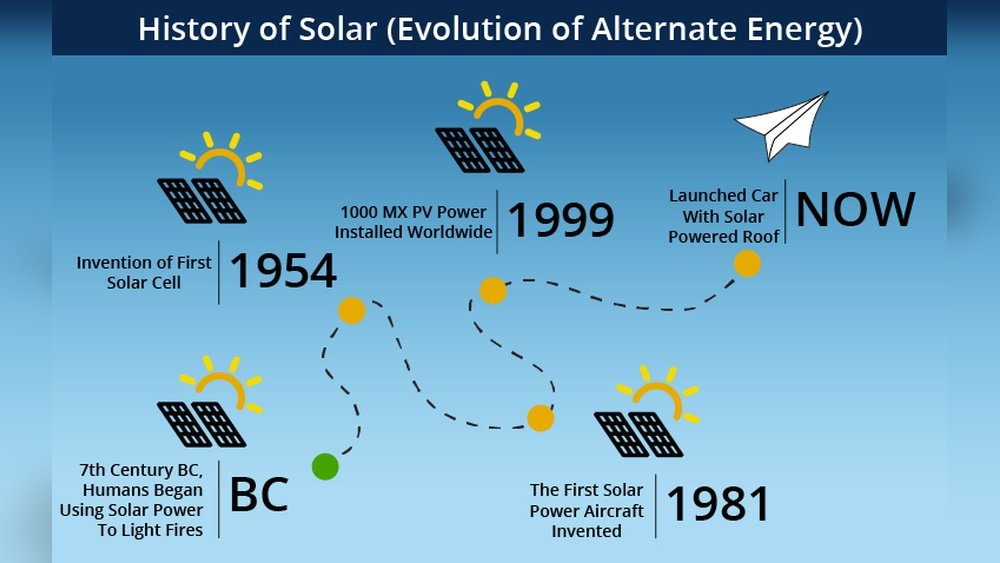
The first real solar panel was built in 1883 by American inventor Charles Fritts. He coated thin layers of gold on selenium wafers to make a device that converted sunlight into electricity. Fritts’s panel had an efficiency of about 1%. He imagined that solar panels might eventually compete with coal for energy production. But at the time, his invention was used mainly for demonstration, since it was expensive and weak.
Fritts installed his panels on rooftops in New York City for testing and even wrote about their potential for future energy. He hoped that improvements in materials would someday make solar power practical. His panels were the first to look like modern solar modules, with multiple cells wired together.
Key insight: Fritts’s work showed that you could build a device to collect solar energy, not just observe it. This was the first true ancestor of today’s solar panels.
Understanding Efficiency: Why Early Solar Cells Were Not Practical
You might wonder why solar panels did not become popular right after Fritts’s invention. The answer is efficiency.
- Early selenium panels converted less than 1% of sunlight into electricity.
- They were expensive to produce, using rare materials like gold.
- The output was too low to power machines or homes.
At the time, fossil fuels like coal were much cheaper and more powerful. Scientists kept searching for better materials.
It’s important to know that efficiency isn’t just about numbers. Low efficiency means you need very large panels to make a useful amount of power. For example, powering a single light bulb with Fritts’s technology would require a panel as big as a door, made with costly metals.
This made solar energy a scientific curiosity, not a real solution.
Another hidden factor: Manufacturing methods in the 1800s were not advanced enough to make solar panels at scale. Even if the efficiency was higher, making thousands of panels would have been extremely difficult.
The Silicon Revolution: The Birth Of Modern Solar Panels
The real breakthrough came with the use of silicon—an abundant element used in sand and rocks.
Russell Ohl And The Silicon Photovoltaic Cell (1941)
In the late 1930s, Russell Ohl, an engineer at Bell Labs in the United States, was studying impurities in silicon crystals. In 1941, he patented the first silicon solar cell. Ohl’s discovery was accidental: he noticed that a cracked silicon sample produced electricity when light hit the junction (where two types of silicon met).
This was a game-changer. Silicon was far more efficient than selenium, and it could be manufactured in larger quantities.
One detail often missed: Ohl was actually trying to make better radio detectors, not solar cells. His “mistake” showed how breakthroughs can come from unexpected directions. The cracked silicon crystal created a junction (called a “p-n junction”)—the heart of all modern solar cells.
Bell Labs And The First Practical Solar Cell (1954)
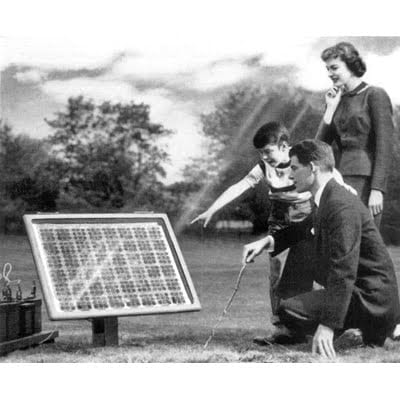
The year 1954 is often called the true “birth” of the modern solar panel. At Bell Laboratories, three scientists—Daryl Chapin, Calvin Fuller, and Gerald Pearson—developed the first practical silicon solar cell.
- Their cell converted about 6% of sunlight into electricity.
- It was strong enough to power small electronics, like a radio.
- Bell Labs announced the invention to the public, and media called it “the beginning of a new era.”
For the first time, a solar cell could do useful work. This invention is what most people mean when they ask, “When were solar panels invented? ”
A practical example: Bell Labs put their solar cells on a small model Ferris wheel and a toy radio to show they could work with no battery or fuel. This demonstration inspired engineers and investors, proving that solar electricity was no longer just a dream.
Key insight: The 1954 Bell Labs cell is the direct ancestor of today’s panels. Its basic design—silicon wafers, metal contacts, and a glass cover—remains the same.
The Early Uses Of Solar Panels
After Bell Labs, solar panels were still too expensive for most uses. However, they found important roles in special areas.
Powering Spacecraft (1950s-1960s)
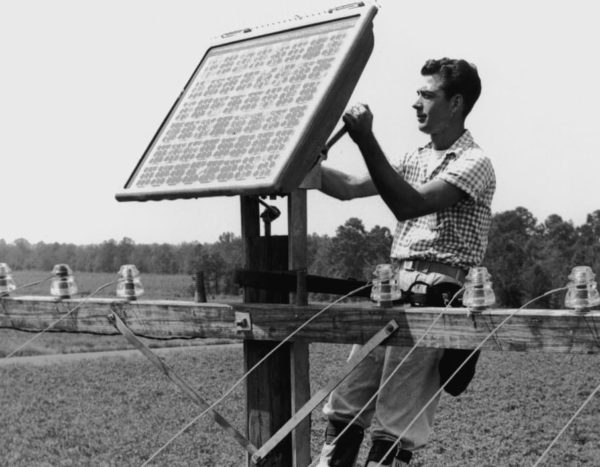
The first big application of solar panels was in space exploration. In 1958, the Vanguard 1 satellite became the first spacecraft to use solar cells. The cells powered its radio transmitter for years, much longer than chemical batteries could.
The space industry became a key customer for solar panels. In space, solar panels were lighter and lasted longer than any other power source. The extreme environment (no maintenance, high radiation) made reliability critical. Solar cells helped power not just satellites, but also space probes sent to the Moon, Mars, and beyond.
Soon, nearly all satellites and space probes used solar panels. In space, sunlight is strong and constant, and solar cells don’t need fuel or maintenance. This helped drive improvements in panel design and reliability.
Remote And Niche Applications
In the 1960s and 1970s, solar panels were used for:
- Remote telephone relay stations
- Weather monitoring stations
- Lighthouses and navigation buoys
- Small calculators and watches
These were places where running power lines was impossible or too costly.
A specific example: In the 1970s, Japan used solar-powered lighthouses on remote islands. These lighthouses needed power 24/7 but were too far from the grid. Small solar panels, combined with batteries, made them fully automatic for years.
Extra insight: These early uses taught manufacturers how to make solar panels last for decades in harsh conditions—knowledge that later made home solar systems reliable.
Falling Costs And Rising Efficiency: Solar Panels For Homes
At first, solar panels were very expensive—sometimes hundreds of dollars per watt. But as technology improved, prices began to fall.
The Energy Crisis And Solar’s Growth (1970s)
The oil crises of the 1970s made many countries look for new energy sources. Governments began funding solar research. Companies started making panels for homes, cabins, and remote equipment. In 1973, the University of Delaware built “Solar One,” one of the first solar-powered houses.
This period also saw the creation of government incentives, tax credits, and research programs. For example, the U. S. Department of Energy was founded in 1977, with solar power as a core focus.
Mass Production And The 1980s
By the 1980s, factories in Japan, the US, and Europe began producing more solar panels. Efficiency slowly improved, reaching 10-15% for commercial modules. Costs dropped as manufacturing scaled up.
Solar panels started to appear on rooftops, powering water pumps, traffic signals, and off-grid cabins. The idea of solar electricity for ordinary people was finally becoming possible.
A detail often missed: Japanese companies like Sharp and Kyocera were early leaders in mass-producing solar panels. Their focus on quality control and new production methods helped bring prices down. By the late 1980s, solar power was no longer just for satellites—it was a real option for rural homes, boats, and RVs.
Credit: solarisrenewables.com
The Modern Era: Breakthroughs, Scale, And Everyday Use
Today, solar panels are everywhere—from small gadgets to huge solar farms. The story of their invention continues as engineers find ways to make them even better.
Thin-film Solar Panels
In the 1980s and 1990s, scientists developed thin-film solar cells. These use materials like cadmium telluride or amorphous silicon instead of thick silicon wafers. Thin-film panels are lighter and flexible, opening new uses (like solar shingles and portable panels).
Thin-film is often used for building-integrated solar (BIPV) products, such as solar windows or roof tiles. While their efficiency is usually lower, they can be installed in places where traditional panels don’t fit.
Solar Panel Efficiency Over Time
The efficiency of solar panels has climbed steadily. Modern commercial panels often reach 18-22% efficiency, and laboratory cells have surpassed 40% under special conditions.
Here’s a quick comparison of solar panel efficiency milestones:
| Year | Type | Efficiency | Notes |
|---|---|---|---|
| 1883 | Selenium (Fritts) | ~1% | First solar panel |
| 1954 | Silicon (Bell Labs) | 6% | First practical cell |
| 1970s | Commercial Silicon | 10-14% | Mass production begins |
| 2020s | Modern Silicon | 18-22% | Standard rooftop panels |
| 2020s | Lab Multi-junction | 40%+ | Special conditions |
Non-obvious detail: Higher efficiency isn’t always the main goal. Lower-cost panels with medium efficiency may be better for large projects, while high-efficiency panels are great for small roofs or satellites.
Solar Power Around The World
Solar panels are now a global industry. China, the United States, Germany, and India are leaders in installing solar power.
Here’s how different countries compare for total installed solar capacity (as of 2022):
| Country | Installed Capacity (GW) | Global Share (%) |
|---|---|---|
| China | >300 | ~35% |
| United States | ~100 | ~12% |
| Japan | ~80 | ~9% |
| Germany | ~60 | ~7% |
| India | ~50 | ~6% |
Key insight: The countries leading in solar capacity are also investing in manufacturing and research, making panels cheaper and better worldwide.
Another detail: Some smaller countries (like Denmark or the Netherlands) have high solar use per person, even if their total numbers are lower. This shows how solar can fit different climates and energy policies.
How Do Solar Panels Work? The Science Behind The Invention
Understanding how solar panels work helps explain why their invention was so revolutionary.
Solar panels are made of photovoltaic cells—usually silicon. When sunlight hits a cell:
- Photons (light particles) transfer energy to electrons in the silicon.
- This energy “kicks” the electrons loose.
- The cell’s structure forces electrons to move in one direction, creating a flow of electricity (a current).
- Wires collect the current, sending it to power devices or charge batteries.
A group of cells forms a solar module (or panel). Panels can be connected to make larger systems for homes, businesses, or power plants.
A non-obvious detail: The “p-n junction” in each cell (the meeting point of two types of silicon) is what creates the electric field that drives the electrons. Without this, the electrons would just return to their original position, and no current would flow.
Key Components Of A Solar Panel
- Solar cells (usually silicon)
- Glass cover for protection
- Metal frame for structure
- Wiring and contacts to carry electricity
- Backsheet (protects the back of the panel)
Modern panels also include a thin anti-reflective coating that helps them absorb more sunlight. Even small improvements in these layers can make a big difference in efficiency and durability.
The Evolution Of Solar Panel Materials And Designs
From the first selenium cells to today’s advanced silicon panels, material science has shaped the solar industry.
Silicon: The Mainstay
Crystalline silicon (both monocrystalline and polycrystalline) is the most common material for solar panels. It’s efficient, durable, and widely available.
- Monocrystalline panels are made from a single crystal of silicon. They are usually more efficient but cost more.
- Polycrystalline panels are made from many smaller crystals. They are a bit less efficient but cheaper to produce.
Many homeowners choose polycrystalline panels for price, but monocrystalline panels for limited roof space.
Thin-film Technologies
Thin-film panels use materials deposited in very thin layers, such as:
- Cadmium telluride (CdTe)
- Copper indium gallium selenide (CIGS)
- Amorphous silicon (a-Si)
These panels are lighter and sometimes cheaper, but usually less efficient than crystalline silicon.
Thin-film is often used in large solar farms or places where weight and flexibility matter more than efficiency.
New Frontiers: Perovskite And Multi-junction Cells
Recent research focuses on perovskite solar cells, which have the potential for high efficiency and low cost. Multi-junction cells layer different materials to capture more of the sun’s energy.
Perovskite cells can be printed using simple methods, making them cheaper and possibly more eco-friendly. Multi-junction cells, used mostly in satellites, combine several layers to capture different parts of sunlight, pushing efficiency much higher than single-layer cells.
Key insight: Most rooftop panels today use silicon, but the next revolution could come from new materials.
Common Myths About Solar Panel Invention
Many people believe solar panels are a recent invention. In reality, their roots go back almost 200 years. Here are some common myths:
- Myth: Solar panels were invented in the 1970s.
- Reality: The basic technology was created in the 1800s, with practical panels in the 1950s.
- Myth: Only modern scientists worked on solar energy.
- Reality: Early inventors like Becquerel, Fritts, and Adams made key discoveries long before computers or space travel.
- Myth: Solar panels are only for warm, sunny places.
- Reality: Solar panels work in cold and cloudy regions too; they just need daylight, not heat.
Understanding this long history helps appreciate how much work went into making solar power practical and affordable.
Credit: gienergy.com.au
Notable Figures In Solar Panel History
The journey from experiment to everyday energy involved many creative minds. Here are some of the most important contributors:
- Edmond Becquerel – Discovered the photovoltaic effect (1839).
- Willoughby Smith – Found selenium’s photoconductivity (1873).
- William Grylls Adams & Richard Evans Day – Created the first solid-state solar cell (1876).
- Charles Fritts – Built the first solar panel (1883).
- Albert Einstein – Explained the photoelectric effect, winning the Nobel Prize (1905).
- Russell Ohl – Patented the first silicon solar cell (1941).
- Daryl Chapin, Calvin Fuller, Gerald Pearson – Developed the first practical silicon cell at Bell Labs (1954).
Each of these figures pushed the technology forward, building on earlier discoveries.
A less-known but important figure: Jan Czochralski, who invented the method for growing large single crystals of silicon (the “Czochralski process”). This method is still used to create the silicon wafers for most solar panels.
Timeline: Key Moments In Solar Panel Invention
Seeing the story in a timeline helps make the sequence of breakthroughs clear.
| Year | Event | Key Person(s) |
|---|---|---|
| 1839 | Discovery of the photovoltaic effect | Edmond Becquerel |
| 1873 | Selenium’s photoconductivity found | Willoughby Smith |
| 1876 | First solid-state solar cell | Adams & Day |
| 1883 | First solar panel built | Charles Fritts |
| 1905 | Photoelectric effect explained | Albert Einstein |
| 1941 | First silicon solar cell patented | Russell Ohl |
| 1954 | First practical silicon cell | Chapin, Fuller, Pearson (Bell Labs) |
| 1958 | First solar-powered satellite (Vanguard 1) | NASA |
| 1970s | Commercial production, solar houses | Many |
| 1980s–present | Mass adoption, higher efficiencies | Global industry |
:max_bytes(150000):strip_icc()/GettyImages-463921425-feeecca150344abc9b06f8681d8f870d.jpg)
Credit: www.treehugger.com
Why Did Solar Panels Take So Long To Become Popular?
You might ask: If the basic science was known by the 1800s, why did it take until the 2000s for solar panels to become common?
- Efficiency – Early panels produced little electricity, making them impractical.
- Cost – Manufacturing was expensive, especially with rare materials.
- Competing Technologies – Coal, oil, and natural gas were cheap and easy to use.
- Lack of Demand – Only remote or special uses justified the price before the energy crises of the 1970s.
- Manufacturing Challenges – Mass production needed better tools and global supply chains.
Only when efficiency improved and costs dropped did solar panels become a practical choice for homes and businesses.
Key insight: The timeline of solar panels is a lesson in how technology adoption depends on many factors, not just invention.
Another hidden factor: National policies and incentives made a big difference. Countries that supported solar research and installation (like Germany’s “Energiewende” program) saw much faster adoption. Social and economic factors are just as important as science.
The Impact Of Solar Panel Invention On Society
The invention of solar panels has had a huge impact on how we think about energy.
- Renewable Energy Growth – Solar is now one of the fastest-growing energy sources worldwide.
- Off-Grid Power – Solar panels bring electricity to remote villages, islands, and disaster zones.
- Climate Change – Solar energy reduces dependence on fossil fuels, helping fight global warming.
- Job Creation – The solar industry employs millions, from research and manufacturing to installation.
Solar panels are not just a scientific achievement—they’re changing lives and economies.
A practical example: In rural Africa and Asia, small solar panels charge batteries and run lights, radios, and water pumps. This reduces the need for kerosene lamps (which cause indoor air pollution) and helps children study at night.
Extra insight: Solar panels have also helped after disasters. After hurricanes or earthquakes, portable solar kits can power medical clinics or communication devices when the main grid is down.
Two Insights Beginners Often Miss
- Solar panel invention was not a single event. It involved decades of progress in chemistry, physics, and engineering. Many people imagine a “lightbulb moment,” but real invention is a process.
- Material science is as important as the idea. The early photovoltaic effect was known, but only with the right materials (like silicon) did panels become useful. Understanding the role of materials helps explain why solar panels evolved slowly.
A third insight for curious readers: Public awareness lagged behind invention. Even after panels were practical, many people didn’t know about them until government programs and media attention in the 1970s and 2000s made solar power a household topic.
What’s Next For Solar Panel Technology?
The story of solar panels is still being written. New discoveries could change the way we use solar power:
- Higher efficiencies with multi-junction and perovskite cells
- Lower costs from better manufacturing and recycling
- Flexible and integrated designs (solar windows, car roofs, clothing)
- Energy storage (batteries) making solar more reliable
Some experts see a future where solar panels are built into every surface—windows, walls, cars, and even clothing. Paired with better batteries, solar could power more of our daily lives, even at night.
Non-obvious detail: Recycling old solar panels is becoming a big area of research. As millions of panels reach the end of their life, new methods are needed to recover valuable materials and reduce waste.
The drive for cleaner energy and better technology means solar panels will keep improving.
Frequently Asked Questions
When Were Solar Panels Invented?
Solar panels have a long history. The first device to turn sunlight into electricity was made in 1883 by Charles Fritts using selenium. The first practical silicon solar panel, similar to today’s, was invented at Bell Labs in 1954. So, the invention is a process with key steps in 1839 (photovoltaic effect), 1883 (first panel), and 1954 (modern panel).
Who Invented The First Solar Panel?
Charles Fritts invented the first true solar panel in 1883. He built a panel using selenium coated with a thin layer of gold. However, this panel was not efficient enough for practical use. The first modern (silicon) solar panel was created by Daryl Chapin, Calvin Fuller, and Gerald Pearson at Bell Labs in 1954.
Why Did It Take So Long For Solar Panels To Become Popular?
Early solar panels were too inefficient and expensive for everyday use. Fossil fuels were cheaper and easier to use. Only after improvements in efficiency, manufacturing, and falling costs (especially after the 1970s) did solar panels become practical for homes and businesses.
How Efficient Are Solar Panels Today Compared To The Past?
The first solar panels (in the 1880s) were about 1% efficient. The 1954 Bell Labs cell was 6%. Today’s commercial silicon panels are 18-22% efficient. Laboratory cells can reach over 40% efficiency using advanced materials.
Where Can I Learn More About The History Of Solar Panels?
A good resource is the Wikipedia article on the history of solar cells. It gives detailed timelines, inventor biographies, and the science behind the technology.
Solar panels are a great example of how curiosity, persistence, and science can create world-changing technology. Today, they bring clean power to millions—and their story is still unfolding.